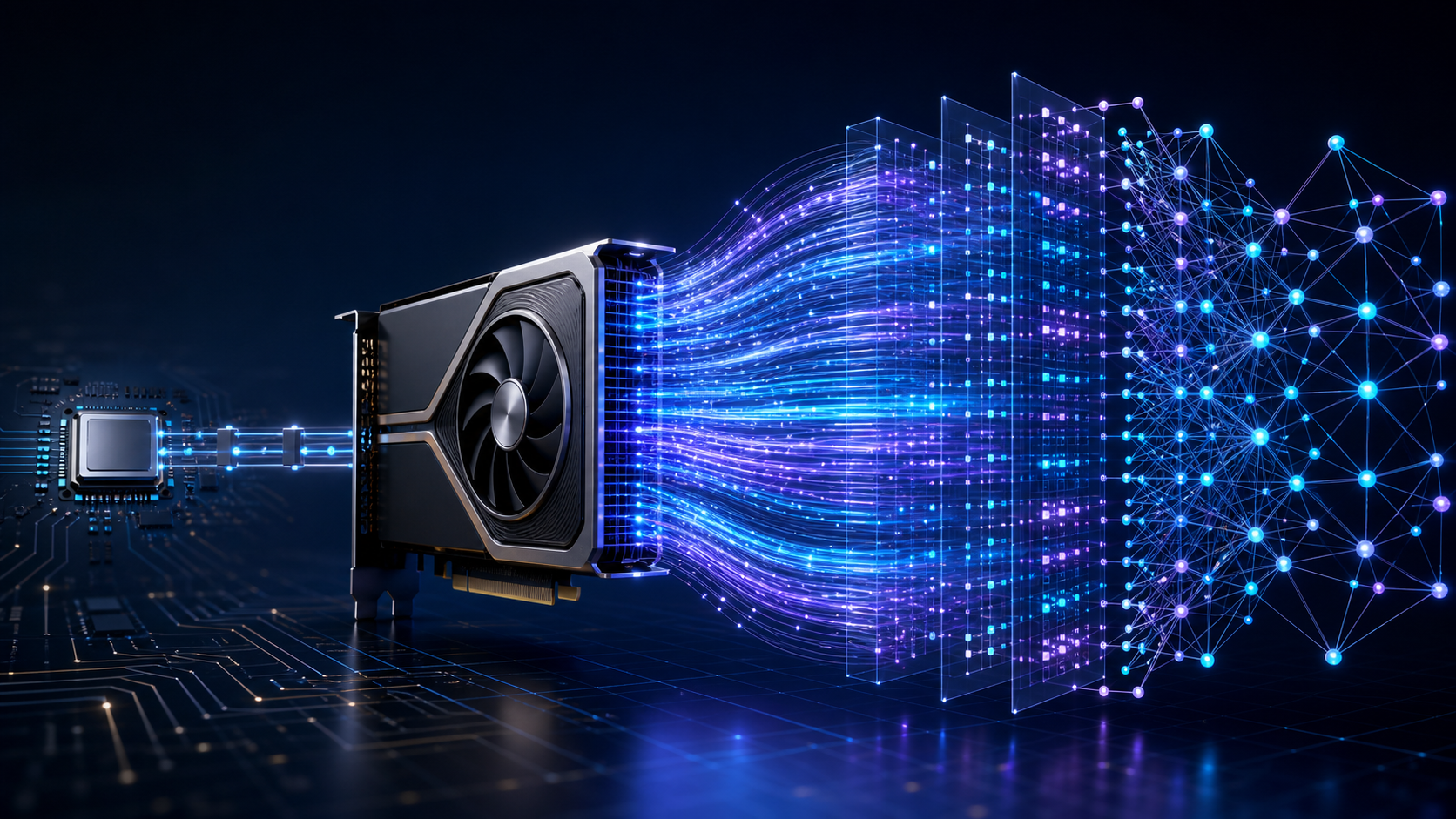
Large language models can write, summarize, translate, and answer questions, but underneath those abilities is an enormous amount of arithmetic. Every response requires the model to repeatedly multiply large arrays of numbers. A central processing unit can perform this work, but a graphics processing unit is usually much faster because its architecture matches the calculation pattern of a neural network.
This is why GPUs are commonly described as “required” for LLMs. The precise answer is more nuanced: a GPU is not a strict requirement for every language model, but it is the hardware that makes training large models and serving them at useful speeds economically practical.
The short answer
LLMs rely heavily on matrix multiplication. A CPU has a relatively small number of powerful cores designed to handle varied tasks and complicated control logic. A GPU has thousands of smaller processing units that can perform many similar calculations at the same time. Because the same mathematical operation must be applied across millions or billions of model values, this parallel design gives GPUs a major advantage.
GPUs also provide high memory bandwidth and specialized low-precision hardware. Together, these features allow them to move model data quickly and complete far more neural-network operations per second than a general-purpose CPU.
What an LLM actually does
An LLM does not store complete sentences and retrieve the best one. It represents what it learned as numerical parameters, often called weights. When you enter text, the model converts it into tokens, transforms those tokens into vectors, and passes the vectors through many neural-network layers.
The dominant operation in those layers is matrix multiplication. Attention calculations compare tokens with one another, while feed-forward layers transform the representation of each token. Both involve applying the same arithmetic to large collections of numbers. The model performs these operations once for the prompt and then repeatedly as it predicts each new token.
A single multiplication is easy. The challenge is the scale: useful models may contain billions of parameters, and generating one response can require billions or trillions of arithmetic operations.
1. GPUs perform calculations in parallel
A CPU is optimized for flexibility and low latency. Its cores are good at operating systems, application logic, branching instructions, databases, and workloads in which each step may differ from the previous one.
A GPU was originally built to calculate many screen pixels and vertices simultaneously. Neural networks happen to need a similar kind of parallelism. Instead of asking a few powerful cores to work through a matrix mostly in sequence, a GPU divides the matrix across many processing units and calculates large parts of it at once.
Imagine that 10,000 simple calculations must be completed. A CPU is like a small group of highly skilled workers who can solve many different problems. A GPU is like a much larger team trained to perform the same operation together. For a repetitive, divisible workload such as matrix multiplication, the larger team finishes sooner.
2. LLMs need fast access to memory
Compute speed is only part of the story. The processor must continually read model weights from memory. If those values cannot arrive quickly enough, the arithmetic units sit idle no matter how powerful they are.
GPUs use high-bandwidth memory systems designed to move large blocks of data rapidly. This is especially important during token generation, when the model may need to read much of its weight data for every new token. For many inference workloads, memory bandwidth is as important as raw calculation speed.
Memory capacity matters too. A model must fit in the combined memory available to the hardware, along with its temporary activations and key-value cache. If it does not fit on one GPU, it may need to be split across several GPUs or compressed through quantization.
3. Specialized units accelerate AI arithmetic
Modern data-center and consumer GPUs include hardware designed specifically for matrix operations. These units can process lower-precision number formats very efficiently. LLMs usually do not need every calculation to use the 64-bit precision common in scientific computing. Training often uses a mixture of 16-bit and 32-bit formats, while inference may use 16-bit, 8-bit, or 4-bit representations.
Using fewer bits has two benefits: each value occupies less memory, and more values can be processed in a single hardware operation. The result is faster computation and a larger model fitting into the same amount of memory. Careful quantization can reduce hardware requirements while preserving most of the model’s useful quality.
Training needs much more hardware than inference
Training teaches a model by processing huge datasets, measuring prediction errors, and updating its weights. It includes a forward pass to produce predictions and a backward pass to calculate gradients. Optimizers also maintain extra numerical state. This makes training far more memory- and compute-intensive than simply using a finished model.
Training a frontier-scale LLM can require large clusters of accelerators working continuously. The GPUs must communicate quickly because different parts of the model and training batch are distributed across them. Fast interconnects, storage, networking, cooling, and power delivery become part of the system—not just the chips.
Inference uses an already trained model to process a prompt and generate output. It requires less hardware, but speed still matters. A conversational product must respond without making the user wait too long, and a service may need to handle many requests at once. GPUs improve both response speed and throughput.
Why not just use more CPUs?
It is possible to distribute LLM work across CPUs, and servers with large amounts of system memory can hold models that do not fit on a single consumer GPU. However, adding CPU cores does not automatically provide the same matrix throughput or memory bandwidth as accelerators designed for parallel numerical work.
CPUs can still be the right choice when:
the model is small or heavily quantized;
response time is not important;
the model is used only occasionally;
the application must run on hardware without a supported GPU;
cost or power limits matter more than maximum speed; or
the CPU handles surrounding tasks while another device runs the model.
For a local experiment, CPU inference can be perfectly adequate. For training a large model or serving many users, GPUs and other AI accelerators are normally more practical.
How much GPU memory does an LLM need?
A useful first estimate for inference is the number of parameters multiplied by the bytes used for each parameter. A 7-billion-parameter model stored at 16 bits needs roughly 14 GB for weights alone. At 8 bits, it needs roughly 7 GB; at 4 bits, roughly 3.5 GB. Real applications require additional memory for runtime overhead, temporary values, and the key-value cache, so the model needs more than this simple estimate.
The context length, number of simultaneous users, batch size, software framework, and quantization method all change the final requirement. Training needs considerably more memory because it must also store gradients, activations, and optimizer state.
Is a GPU always faster?
No. Moving data to a GPU and launching parallel work has overhead. A tiny model or a very small operation may finish faster on a CPU. Performance also depends on optimized software, supported data types, memory capacity, and whether the workload can keep the GPU busy.
A GPU with impressive theoretical performance can still be a poor fit if the model does not fit in its memory. Sending part of the model back and forth between GPU and system memory may erase much of the speed advantage. The best hardware is the hardware that fits the entire workload, not simply the device with the largest headline number.
GPUs are not the only AI accelerators
The real requirement is efficient hardware for large tensor and matrix operations. GPUs are widely used because they are programmable, supported by mature software ecosystems, and available from laptops to cloud clusters. Other processors—including tensor processing units, neural processing units, and custom inference chips—can run the same broad class of workloads.
For developers, software compatibility is often as important as chip specifications. Model frameworks, numerical libraries, drivers, and deployment tools determine whether the hardware’s performance is actually accessible.
The bottom line
GPUs make LLMs practical because they combine massive parallelism, high memory bandwidth, and specialized support for low-precision matrix arithmetic. Training large models would take prohibitively long on ordinary CPUs, while GPU inference makes interactive responses and high-volume services possible.
Still, “LLMs require GPUs” is a useful shortcut rather than an absolute rule. Small and quantized models can run on CPUs, phones, and other accelerators. The larger the model, the longer the context, and the more users a system must serve, the stronger the case becomes for a GPU or another purpose-built AI accelerator.